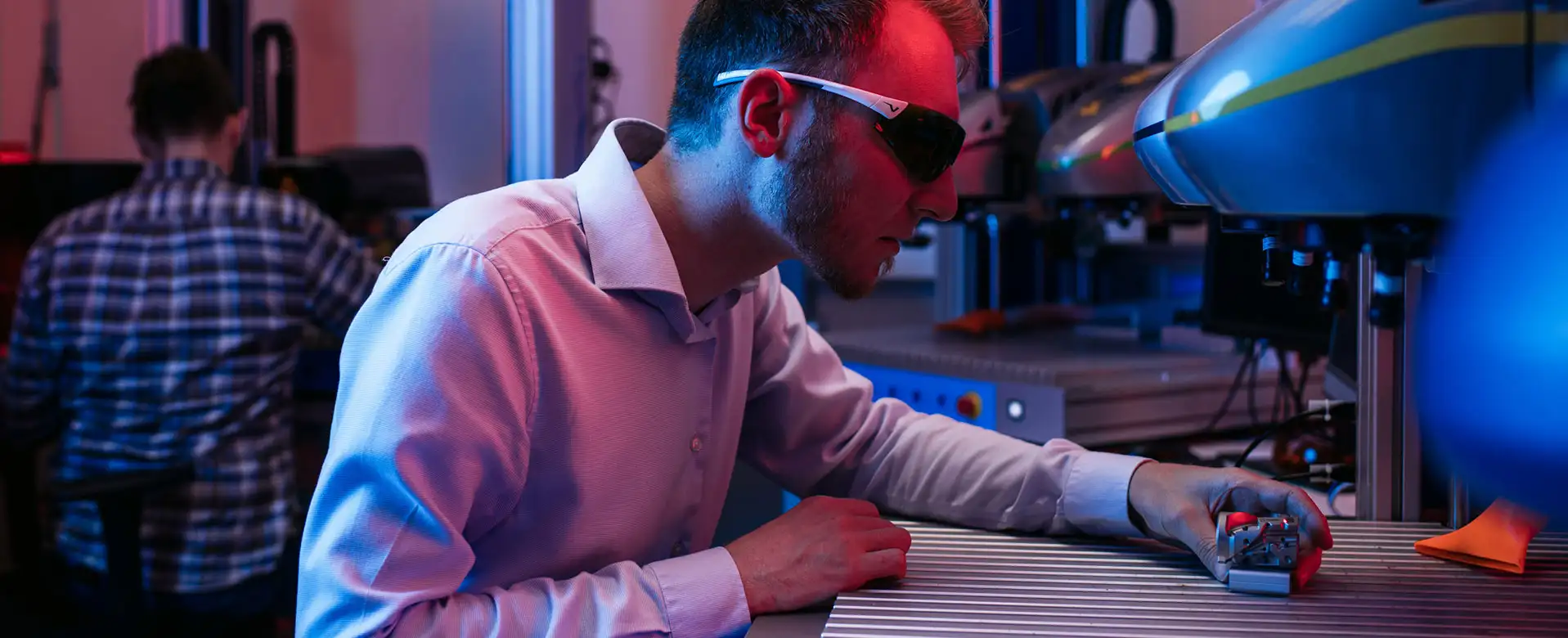

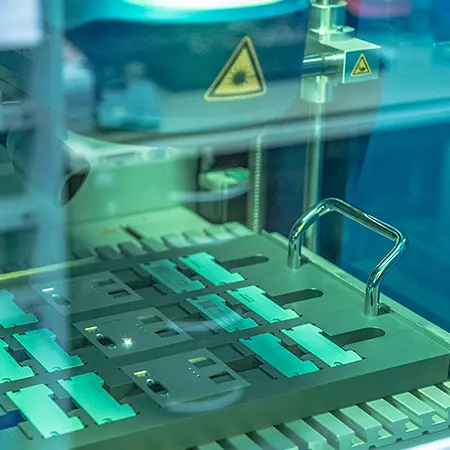
Techniker im Labor am Beschriftungslaser und Metallbauteil darunter

Knowledge of laser processes, laser systems, and applications

Glossary of Industrial Laser Marking

An overview of terms, procedures, and systems

This glossary provides technical guidance on key terms in industrial laser marking. It links fundamental processes and laser types to topics such as software, traceability, process quality, and project implementation. In this way, the glossary helps users understand technical relationships and better evaluate suitable solutions for various applications.

All | A B C D F L M O P S T U V W Z
A

Ablation / Material Removal
Ablation, or material removal, refers to the targeted removal of material or surface layers using a laser. The process is used for applications such as engraving, paint removal, layer removal and high-contrast marking. Key factors include wavelength, pulse duration, focal position and energy density.

More about »Applications«

More about »Metals«


Annealing Marking
Annealing marking is a thermal marking process in which the surface is locally discolored without creating a deep engraving. It is suitable for high-contrast, permanent and material-friendly markings on metallic materials. An exact focal position is especially important for stable marking quality.

More about »Applications«


Application Consulting
Application consulting is technical advice for selecting the right process, laser type, marking principle and system concept. The focus is on material, geometry, quality requirements, cycle time, readability and future integration capability. It therefore provides an important basis for a technically sound assessment of an application.

More about »Products & Solutions«

More about »Customized Solutions«


Auto Focus
Auto Focus refers to the automatic focusing of the laser on the actual workpiece height. This improves precision and repeatability when component heights, tolerances and focus-critical processes vary. Especially with varying workpiece geometries, Auto Focus supports stable marking quality.

More about »Auto Focus – Automatic Focusing in Laser Marking«


Automation
Automation describes the integration of a laser system into manual, semi-automatic or fully automatic production processes. This includes parts handling, robotics, interfaces, camera alignment and automated inspection processes. The aim is reproducible, efficient and process-reliable integration into existing workflows.

More about »Customized Solutions«


B

Black Marking
Black marking is a special form of high-contrast marking that creates very dark and permanently legible marks. The process is used wherever high optical quality, durability and good readability are important. This makes black marking particularly suitable for applications with high requirements for contrast and appearance.

More about »Black Marking«

More about »Applications«


C

CO₂ Laser
CO₂ lasers are laser sources in the infrared spectral range and are particularly suitable for organic materials, many plastics, paper, wood, films and coated surfaces. They are mainly used for non-metallic materials. This makes them an important laser source for material-specific applications outside metal processing.

More about »Products & Solutions«


Consulting
Consulting is the technical support provided from the initial task through to the suitable technical solution. It includes material and process evaluation, safety and integration concepts, software questions and economic framework conditions. It helps clarify requirements early and assess solutions on a sound basis.

More about »Products & Solutions«

More about »Application Consulting«


Cycle Time
Cycle time describes the time required for a complete processing cycle, including feeding, positioning, marking and, where applicable, inspection. It has a significant influence on the selection of the system concept, degree of automation and software logic. Cycle time is therefore a central factor in evaluating productivity and process design.

More about »Customized Solutions«

More about »Laser Stations«


D

DataMatrix Code
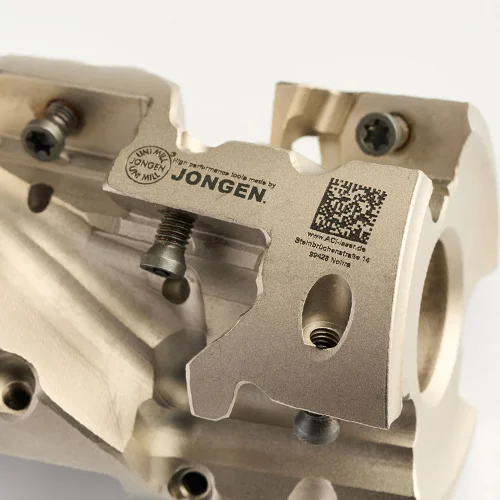
The DataMatrix code, also known as a Data Matrix code, is a two-dimensional code with high information density that is widely used in industrial direct marking. It enables automated readability and supports unique traceability of components and products. As a result, it plays a central role in quality-critical processes.

More about »Vision & Code Reading Systems«

More about »Applications«


Direct Part Marking (DPM)
Direct part marking, often referred to as DPM, means marking a component directly without a separate label or additional carrier. Typical content includes serial numbers, logos, batch codes or 2D codes. The process is particularly relevant for permanent traceability and tamper-resistant marking.

More about »Applications«

More about »Vision & Code Reading Systems«


F

Fiber Laser
Fiber lasers are widely used industrial laser sources for precise, fast and permanent marking and engraving. They are particularly suitable for metals and many engineering plastics and stand for high beam quality, dynamics and good integrability into systems and production lines. This makes them one of the key laser sources in industrial marking.

More about »Fiber Lasers«


Focus
The focus is the area of highest energy density of the laser beam on the workpiece. Its exact position directly influences contrast, line width, engraving depth and reproducibility. The focus is therefore a central parameter for the quality and stability of marking processes.

More about »Auto Focus – Automatic Focusing in Laser Marking«


L

Laser Batch / Laser Marking Masterbatch
A laser batch is a special masterbatch for plastics. It is a highly concentrated granulate containing laser additives—that is, functional additives that specifically influence the interaction between the plastic and laser radiation. The laser batch is mixed into the plastic during processing to improve its laser-markability and, depending on the material, color, and laser source used, to enable high-contrast and reproducible markings. Suitability depends on the plastic, the material color, the laser batch used, and the laser source employed.

More on “Plastics”

More on “Laser Marking”


Laser Engraving
Laser engraving is a material-removing process that creates a permanently recessed marking. Unlike purely color-based surface changes, material is deliberately removed. This makes laser engraving particularly suitable for robust markings, logos and functional structures.

More about »Laser Engraving«


Laser Marking
Laser marking is the umbrella term for processes in which a laser creates a permanent mark on a workpiece surface. Depending on the material and process objective, the effect is produced, for example, by annealing, ablation, foaming, color change or other material-dependent effects. The term therefore covers various marking principles used in industrial identification.

More about »Laser Marking«


Laser Software
Laser software is used to create layouts, variable data, process parameters and workflows, as well as to connect peripheral devices and interfaces. It is essential for reproducible, safe and efficient marking processes. It therefore forms an important basis for controlling and standardizing industrial laser applications.

More about »Software«

More about »Magic Mark«


Laser Trimming
Laser trimming is a precision process for targeted functional fine adjustment of components. Controlled material removal can be used to set electrical or functional properties within tight tolerances. This clearly distinguishes the process from purely informative marking processes.

More about »Laser Trimming«

More about »Applications«

More about »CPM Vision System«


M

Magic Mark
Magic Mark is laser software for marking programs as well as for monitoring and controlling laser systems and peripheral devices. Plugin-based extensions make it easier to adapt the software to application-specific requirements. This allows the software to be flexibly integrated into different marking and process environments.

More about »Magic Mark«

More about »Magic Mark Plugins«


Manual Workstation
A manual workstation is a manually operated laser workstation for flexible product changes, sample marking and smaller batch sizes. Typical features include compact, protected systems with good accessibility and optional modules such as a camera, Z axis or rotary axis. This makes a manual workstation especially suitable for variable applications and frequently changing components.

More about »Laser Stations«


MOPA Laser
MOPA lasers are fiber laser architectures with variable pulse characteristics and an expanded parameter range. They are especially suitable when thermal input, contrast effect or fine process adjustments need to be influenced in a targeted way. This gives them a high degree of flexibility for demanding marking tasks.

More about »Marking Lasers«


O

OPC UA
OPC UA is a standardized communication protocol for the secure and structured exchange of data between machines, plants, and software systems. It enables information to be made available and exchanged across systems and manufacturers. In this way, OPC UA supports the networking and automation of industrial production processes.

More about »OPC UA Plugin«


P

Parameter Window
The parameter window describes the range of suitable process parameters within which a marking or machining process reliably achieves the desired quality. These parameters include power, pulse duration, frequency, focal position, scanning speed and line spacing. A viable parameter window is essential for reproducible and robust processes.

More about »Applications«

More about »Customized Solutions«


Pulse Duration
Pulse duration describes the temporal length of an individual laser pulse. It influences how energy is coupled into the material and whether the result is primarily ablation, discoloration, annealing or material-friendly precision processing. Pulse duration is therefore one of the key factors in selecting and fine-tuning laser processes.

More about »Marking Lasers«


S

Sample Marking
Sample marking is the practical preliminary test on original material or representative components. Marking process, contrast, heat impact, readability, engraving depth and the viable parameter window are evaluated under realistic conditions. It creates a reliable basis for selecting and assessing a solution.

More about »Sample Creation«

More about »Applications«


Service
Service includes planned and reactive technical services related to commissioning, maintenance, system availability, spare parts and support during ongoing operation. Good service is a key factor for stable processes and low downtime. It helps companies operate laser systems reliably and economically over the long term.

More about »Support & Service«


Support
Support is technical assistance with questions related to application, parameterization, software, troubleshooting and ongoing operation. It complements service with a stronger knowledge- and application-oriented component. Support helps identify problems more quickly and manage processes more reliably in everyday operation.

More about »Support & Service«


T

Traceability
Traceability describes the ability to uniquely identify a component or product throughout production, quality assurance and the supply chain. Laser marking is particularly suitable for this because it is permanent, contactless and can be integrated into the process. Traceability therefore forms an important basis for quality assurance, documentation and transparency in industrial processes.

More about »Applications«


Training
Training is the structured transfer of knowledge for the safe, efficient and quality-stable use of laser systems. It includes operation, software, parameterization, process understanding and maintenance fundamentals. Training helps users implement applications safely and operate processes reliably over the long term.

More about »Software«

More about »Products & Solutions«


U

UV Laser
UV lasers are laser sources with a short wavelength for fine, high-contrast and material-friendly processing. They are mainly used for sensitive materials, small geometries or applications with minimized heat input. This makes them particularly suitable for precise marking tasks with high requirements for detail and material protection.

More about »UV Lasers«


V

Vision System
A vision system is a camera-based system for position detection, marking position control, code verification or quality inspection. Vision solutions increase process reliability, automated correction capability and repeatability. They therefore make a significant contribution to stable, verifiable and reproducible marking processes.

More about »Vision & Code Reading Systems«


W

Wavelength
Wavelength is a central physical property of laser radiation. It has a major influence on how a material absorbs energy and what processing effect is produced. Together with pulse duration and focal position, it is an important factor in selecting suitable laser processes.

More about »Metals«

More about »Products & Solutions«


Web API
A Web API is a programming interface that allows software applications to communicate with each other and call functions using web technologies. In industrial applications, for example, it can be used to control machine or process functions from higher-level systems. Web APIs thus support the integration and automation of software and production processes.

More about »WebAPI Plugin«


Workstation
Workstations are protected laser workplaces for manual, semi-automatic or automated applications. They are suitable for individual parts, small batches and, depending on the system concept, also for series processes with higher requirements for ergonomics, safety and reproducibility. They therefore form an important basis for structured and safe laser applications in industrial environments.

More about »Laser Stations«


Z

Z Axis
The Z axis is the linear height adjustment of the workpiece or optics. It is used for focus positioning and for processing components of different heights, and is often coupled with focus functions or camera-supported processes. This supports precise and repeatable processing of varying workpiece geometries.

More about »Laser Stations«

We’d be happy to assist you further

Search

Press ENTER to confirm or press ESC to close

Cookie Settings

We use cookies on our website. Here you can select whether and, if applicable, which non-essential cookies you wish to accept. You can also find more information about the cookies we use.

EN DE ES FR
Cookie consent by WebThinker

Individual cookie settings

Here you can specify in detail which services you wish to allow. Individual services can be enabled or disabled within each category.
EN DE ES FR
Cookie consent by WebThinker